
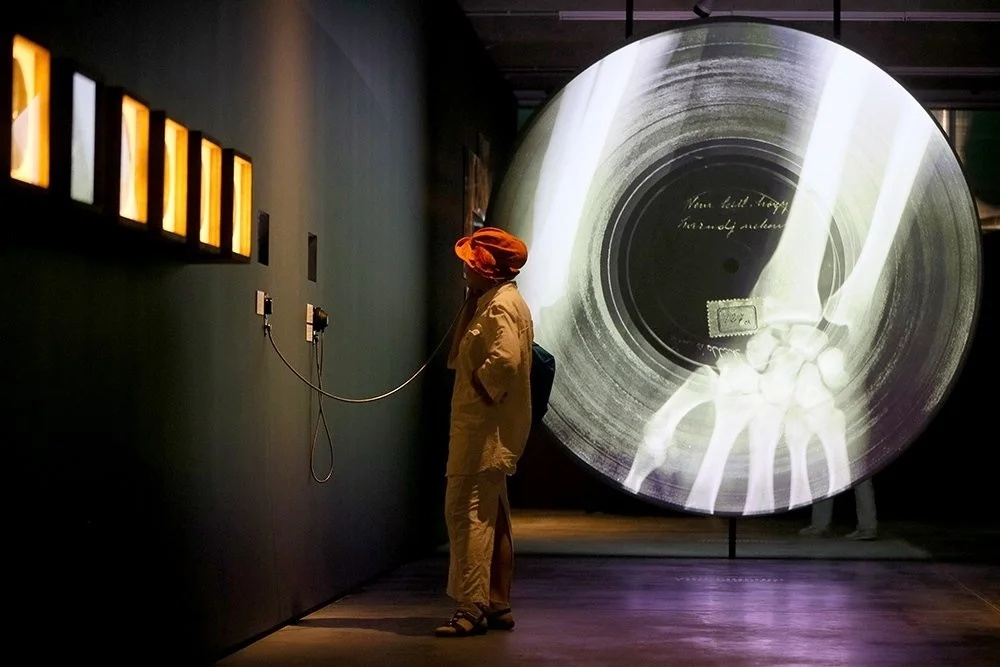
Before vinyl, before cassettes, before anyone in Leningrad could legally hear Elvis, there was a record you could hold up to the light and see a dead man’s ribs.
Every scene has its origin myth. Chicago has the Warehouse. New York has the Loft and the Garage. Manchester has the Haçienda and a punchbowl full of trouble.
Leningrad in the 1950s had a kitchen.
Lights low, door locked, a few friends crowded round a gramophone. Someone pulls a grey, floppy disc out of their coat, and the room goes quiet. The needle drops. Through a wall of hiss you hear it: a saxophone, a backbeat, a voice from a country you will never be allowed to visit. Hold that disc up to the bulb and you’ll see a skull. Or a spine. Or somebody’s broken wrist.
This is bone music, and it might be the most rebellious format in the history of recorded sound.
A Country on Mute
When a foxtrot was a political statement
After the war, Stalin’s Soviet Union treated music the way it treated everything else: as property of the state. Western jazz was the sound of the enemy. Rock’n’roll, when it arrived, was worse. But here’s the bit most people miss. According to Stephen Coates, who has spent more than a decade digging into this world, the real rebel music for many Soviet listeners wasn’t American at all. It was the voices of Russian émigrés who had fled the revolution, gypsy romances, and the bittersweet “criminal” songs of the gulags. Soul music, in its truest sense, for a society that had been cut off from its own culture.
Owning any of it was risky. Making copies of it was a whole other level.

The Golden Dog
A teenage sound engineer, a smuggled machine and a hospital bin
The story usually begins with Ruslan Bogoslovsky, a young Leningrad sound engineer, and his friend Boris Taigin. As the legend goes, they came across a Polish visitor who had sneaked a record-cutting machine into the country. They studied it, copied it, and built their own.
There was just one problem. After the war, vinyl and anything made from petroleum was scarce. So what do you cut a record onto when there’s no plastic?
The answer was lying in the bins behind Soviet hospitals. Old X-rays were considered a fire hazard and had to be thrown out after a year in storage. Thin, tough and flexible, the film turned out to hold a groove surprisingly well. Bogoslovsky started raiding the trash and paying off hospital staff for their castoffs. He and his crew became known as the Golden Dog gang. He would later pay for it with years in a labour camp.

Made One at a Time
How to press a record with a pair of scissors and a cigarette
The process was gloriously DIY. Each X-ray was trimmed into a rough seven-inch circle with scissors. The spindle hole was burned through with a cigarette. Then the disc went on a homemade lathe and the grooves were cut at 78rpm, in real time, one copy after another, usually at night.
“This was a labour of love, not mass production.” – Stephen Coates
Nobody bought these for the audio quality. Russian rock critic Artemy Troitsky remembered the sound as awful, but the price was right: about a ruble or a ruble and a half. Each disc survived maybe five to ten plays before the music wore away. Coates likens the trade to the street market for weed. Dealers hung around near record shops and parks, a disc tucked in their sleeve, waiting for the right kind of customer.
And what a catalogue. Ella Fitzgerald. Elvis. Chubby Checker. Later the Beatles. Alongside them, the banned Russian crooners Pyotr Leshchenko and Alexander Vertinsky. Rock’n’roll on a ribcage. Tango on a pelvis. Nobody was precious about which bone went with which song.
The Crackdown
The state gets wise
Eventually Moscow noticed. A 1958 law banned the home production of recordings belonging to a “criminally hooligan trend.” The hooligans in question were the stilyagi, the style-obsessed kids who wore quiffs, loud ties and drainpipe trousers, copied whatever Western fashion they could get, and danced as if nobody from the Komsomol was watching. Raids followed. Bootleggers went to prison. Then the reel-to-reel tape recorder arrived in Soviet homes in the 1960s, and copying music suddenly got a lot easier. The bones went quiet, ending up forgotten in drawers, attics and flea markets.
The Resurrection
A chance find on a market stall
Decades later, English musician Stephen Coates was touring Saint Petersburg with his band ‘The Real Tuesday Weld’ when he spotted a strange translucent disc on a market stall. That find turned into a full-blown obsession: the X-Ray Audio Project with photographer Paul Heartfield, a book, a touring exhibition, a TEDx talk, the 2016 documentary Roentgenizdat and, more recently, a follow-up book, Bone Music. Coates even tracked down original bootleggers to hear their stories first-hand.
His summary of the whole saga is beautifully simple. It’s a story about how much music matters, and how ingenious people can be.

Next Time…
The bootleggers were smuggling sound in. But across town in Moscow, a decorated Red Army engineer had spent twenty years quietly working on the opposite idea: building a sound that had never existed anywhere, in the East or the West.
His instrument had no keys and no strings. You played it by scratching pictures into black glass.
Part 2 drops tomorrow.


