
A Red Army colonel, a dead composer’s initials and a sheet of black glass.
Meet the ANS, the Soviet synth that turned drawings into sound and gave Tarkovsky’s Solaris its ghosts.

Last time, we were in a Leningrad kitchen, listening to Elvis crackle off somebody’s ribcage. That was the Soviet underground doing what undergrounds do best: sneaking the outside world in. This is the flip side. Same Iron Curtain, same hunger for new sounds. Only this time, the rebel wasn’t a teenage bootlegger. He was a decorated colonel with a Stalin Prize on his shelf.
The Colonel Who Loved Scriabin
From air defence to the avant-garde
Yevgeny Murzin was born in 1914 and trained as an engineer in Moscow. During and after the Second World War he led work on an electro-mechanical anti-aircraft detector, a job important enough to earn him a Stalin Prize and a senior post in the country’s air-defence command.

In his spare time, though, he was thinking about music. Specifically, he was thinking about cinema. Soviet films recorded sound optically: the soundtrack was a wiggly strip of light printed on the side of the film. In other words, you could literally see a sound wave.
So in 1938, still a student, Murzin asked himself a deliciously simple question. If sound can be turned into a picture, why can’t a picture be turned into sound? It took him close to twenty years to answer it. War got in the way, and so did his day job. It wasn’t until 1958 that he finally got a proper laboratory and a team of engineers and musicians to build the thing.
How Do You Play a Drawing?
720 pure tones and a sharp stick
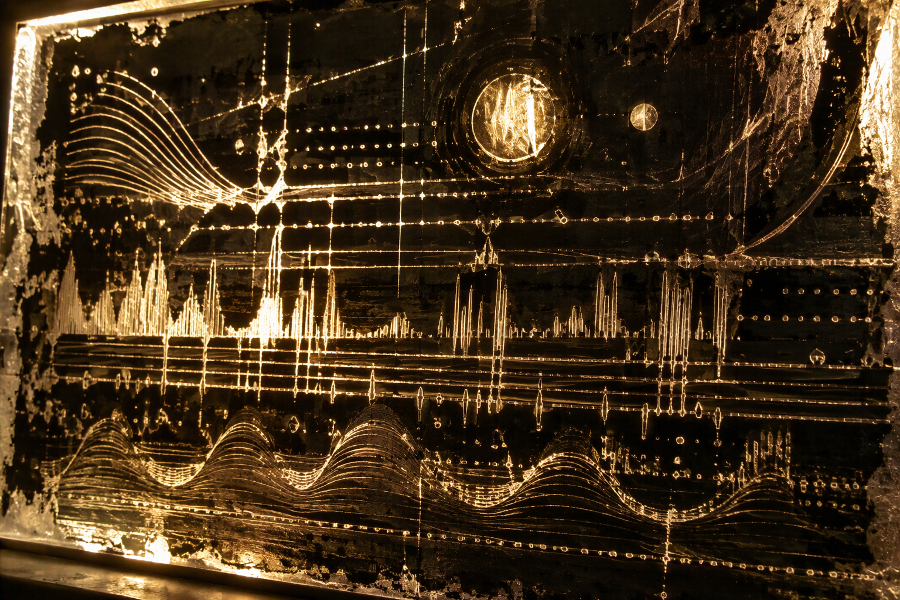
Here’s where things get gloriously strange. Inside the ANS, light shines through five rotating glass discs, each printed with 144 tiny optical “soundtracks” of pure tones. That’s 720 pitches, spread across ten octaves and far more finely divided than any piano.
Instead of a keyboard, the composer gets a glass plate smeared with sticky, black, non-drying mastic. You scratch marks into it. Time runs left to right, pitch runs bottom to top. Wherever you scrape the black away, light slips through, a bank of photocells catches it, and out comes the sound.
A hairline scratch is a single pure tone.
Scrape a vertical stripe and all 720 pitches sound at once.
Stanislav Kreichi, who joined Murzin’s lab as a sound engineer and composer in 1961 and spent decades on the machine, described a pure tone as the most transparent sound there is, because its spectrum is just one line. The ANS let you paint with those lines. Basically, it’s a spectrogram you can play, built decades before your laptop could draw one. The name was Murzin’s tribute to his hero. ANS stands for Alexander Nikolayevich Scriabin, the Russian composer who dreamed of fusing music, colour and light into a single art.
Space Music
The sound of Solaris
The timing was perfect. This was the age of Sputnik and Gagarin, and the ANS sounded like outer space. It was shown in London and Paris and became a prized possession of the Scriabin Museum in Moscow. Composers like Alfred Schnittke, Sofia Gubaidulina, Kreichi and Eduard Artemyev all worked with it.
Artemyev is the one who made it immortal. He used the ANS on Andrei Tarkovsky’s Solaris (1972) and The Mirror, and it also turned up in the hit Soviet comedy The Diamond Arm. Artemyev later said Solaris was the only film of his career where electronics formed the very basis of the score. Watch that film again and listen for the shimmer under the images. That’s Murzin’s machine.
The heartbreaking bit? Murzin died in 1970. He never heard his invention fill a cinema.

Still Humming
From museum piece to Coil
Today the ANS lives at the Glinka Museum of Musical Culture in Moscow, and it still has a cult following. In 2003 the British band Coil released an entire album called ANS made on the machine. In 2010 German artist Carsten Nicolai paid tribute to Murzin with a live performance on it. Want to have a go? There’s a free browser emulator from PIXEL-FM where you can scratch out your own score with a mouse or a finger and hear it back. Fair warning: it’s properly addictive.
Two Sides of the Same Curtain
Put the two stories side by side and they rhyme. In Leningrad, kids carved music into X-rays because the state wouldn’t let the world in. In Moscow, a colonel carved music into glass because he wanted to hear something the world hadn’t made yet.
One smuggled sound in. The other invented it at home. Between them they prove what every dancefloor already knows: you can ban a record, but you can’t ban the itch to hear something new.
Missed Part 1? Read “Music on the Bones”


